Kingdom of Kubala Clout Chasing Scam For Online Money
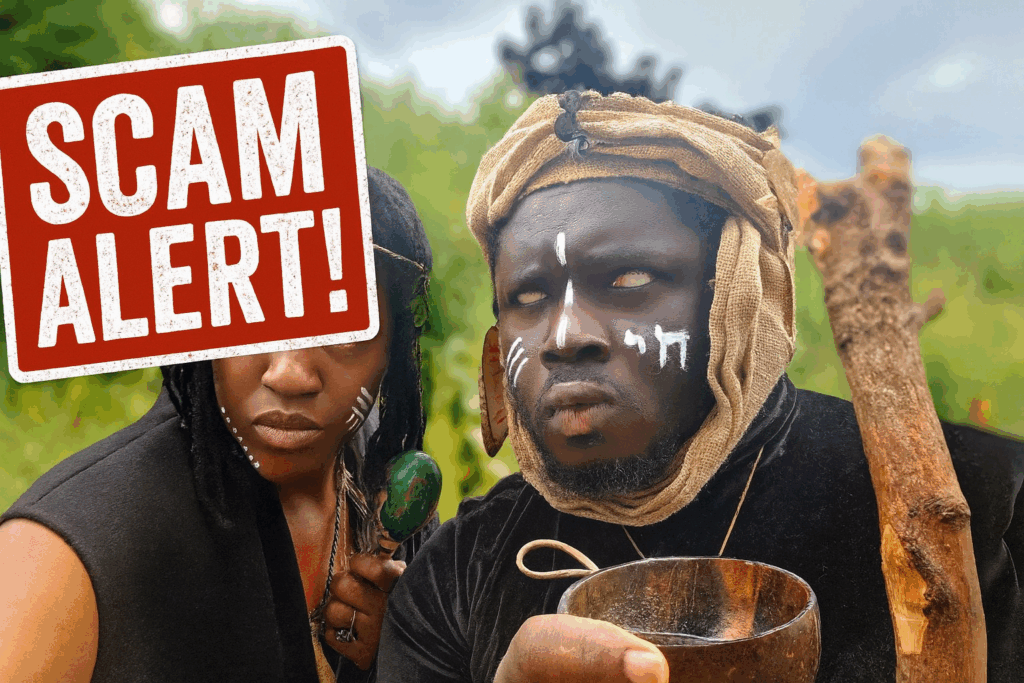
In the rolling hills of Jedburgh, the sound of bagpipes and border history has been replaced by something stranger: tents in the woods, a man and woman calling themselves royalty, and a young American woman branded their “handmaiden.” They named their camp the Kingdom of Kubala, claiming it was the return of a long-lost African dynasty to ancestral land in Scotland.
The story has captivated headlines worldwide. But strip away the theatrics, and a darker truth emerges: Kubala isn’t a kingdom. It’s a scam. A carefully staged performance built to trend online, feed controversy, and convert outrage into money.
A MYTH WITH NO ROOTS
Kofi Offeh, styling himself “King Atehene,” and his wife Jean Gasho, known as “Queen Nandi,” insist they are descendants of black Highlanders driven out centuries ago, heirs to a kingdom erased from history. They claim divine authority, link themselves to King David, and declare Scotland their promised land.
Yet no historian, no archive, and no court record backs their story. Experts have dismissed it as fiction. To the Scottish sheriff courts, their woodland occupation is nothing more than unlawful squatting. But to social media, it’s drama worth watching. And that’s exactly where the Kubala leaders thrive.
TURNING CONFLICT INTO CONTENT
From the start, the Kubala trio treated eviction orders like props. They burned court papers on camera, turned confrontations with locals into viral clips, and accused authorities of persecuting them for their faith. Each outburst became content, and each video brought new waves of attention.
Angry townsfolk shouted at them to leave. Stones were thrown, tents damaged. Instead of deterring them, the chaos fueled their story. The couple framed themselves as victims of racism, martyrs of prophecy, and keepers of a lost kingdom. On TikTok and Facebook, outrage turned into views — and views turned into donations.
FOLLOWING THE MONEY
The Kingdom of Kubala’s true crown is not land or heritage, but monetization. Supporters were encouraged to send gifts, donate cash through apps, and tune into livestreams where the king and queen preached their gospel. Their occupation cost them nothing — no rent, no property taxes, no infrastructure. The only investment was controversy, and the returns came in hard currency from digital platforms.
It was a business model disguised as a spiritual crusade: keep trending, keep fighting, keep feeding the audience. The woodland became a stage, and the world became their paying crowd.
A HISTORY OF HUSTLES
The scam becomes clearer when placed against the couple’s past. Offeh has been linked to multiple failed businesses in Britain — entertainment outfits, property companies, retail ventures — all of which collapsed. Gasho has long courted attention with controversial blogging and online drama.
Together, they have perfected the cycle: create scandal, attract outrage, and reap attention. Kubala is simply their latest reinvention — with crowns instead of company logos, and a forest instead of an office.
THE “HANDMAIDEN” ANGLE
Perhaps the most troubling part of the saga is 21-year-old American Kaura Taylor, who now calls herself “Asnat.” Reported missing by her family in Texas, she reappeared in Scotland, loyal to Kubala’s rulers. Her mother insists she has been brainwashed, reduced to a servant in a manufactured monarchy.
The Kubala leaders deny this, claiming she is there by choice. Yet her presence adds exactly what the scam needs: a subplot of mystery, fear, and human drama. She transforms the spectacle from quirky occupation to international scandal — guaranteeing coverage, clicks, and sympathy from different sides.
THE KINGDOM OF ATTENTION
In the end, Jedburgh has not become the seat of a resurrected African empire. It has become the set of a viral play. The Kubala leaders don’t wear crowns for tradition — they wear them for the camera. They don’t burn eviction notices as defiance — they burn them for content.
Their kingdom is not built on history or justice. It is built on engagement. The real land they occupy is the digital battlefield of trending feeds, where attention equals power and spectacle equals profit.
THE FINAL VERDICT
The Kingdom of Kubala is not a sovereign state. It is not a lost tribe reclaiming heritage. It is a social media hustle — one of the strangest in recent memory. A scam dressed in royal robes, designed to turn chaos into currency and deception into digital fame.
And while the courts prepare to evict them from Scottish soil, their true empire continues online, where the crowns of Kubala shine brightest not as symbols of ancestry, but as the props of a perfectly staged scam.

The Southern Live is your premier source of news and stories from the dynamic and vibrant landscapes of Southern Africa. We are dedicated to shedding light on the voices that often go unheard, particularly those of women, youth and other vulnerable and minority groups who are integral pillars of our society. Our mission is to amplify these voices, providing a platform where the stories, achievements, and challenges of society take center stage. We believe in the power of storytelling to drive positive change, and we are committed to fostering a more inclusive and equitable world.